
Dunham: “Our members are professional business builders … They go find businesses that are struggling or businesses that are doing just fine and they help them level up. They help them be great.”
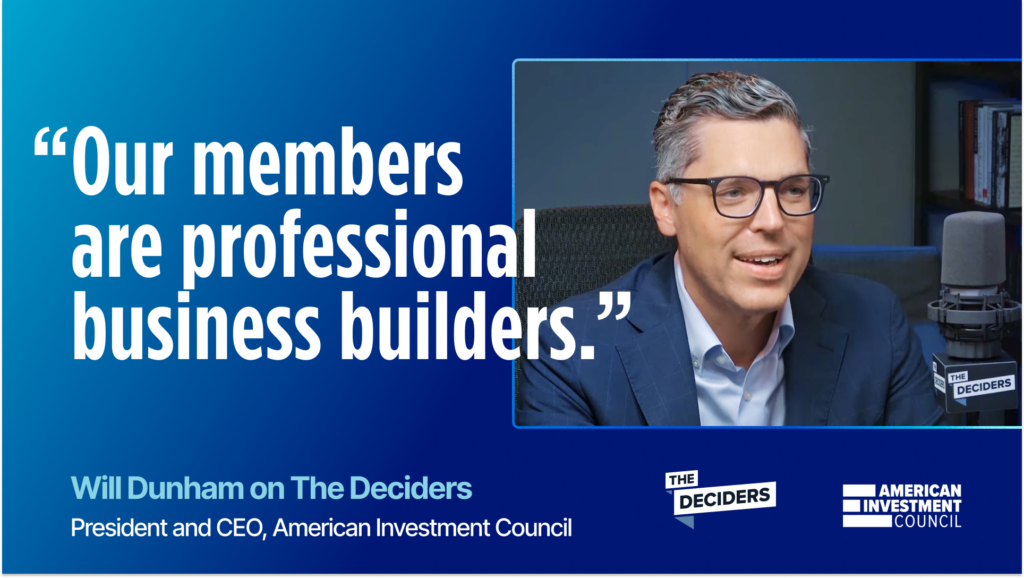
WASHINGTON, D.C. – American Investment Council (AIC) President and CEO Will Dunham recently joined The Deciders, hosted by Pulitzer Prize-winning journalist Brody Mullins and communications strategist Lisa Camooso Miller, for a wide-ranging conversation about AIC and how private equity supports businesses, workers, and retirement security across the country.
Dunham shared his path to leading AIC, from being raised by on a small farm in Ohio to spending nearly 15 years on Capitol Hill, where he ultimately served as a top policy adviser to then-House Republican Leader Kevin McCarthy.
Supporting Small Businesses Across America
Dunham highlighted private equity’s deep investment in Main Street businesses, noting 85 percent of private equity investment goes to small and medium-sized businesses with 500 employees or fewer. These investments support businesses and jobs in communities across the country:
“The investments are really going to Main Street. And I think they’re going all over the country, every state, every district. And we at AIC make it a point every time we sit down with a lawmaker to give them a sheet of paper that tells them the dollars, the businesses, the jobs that have been created in their district thanks to private equity and private credit.”
Dunham pointed to Van Leeuwen Ice Cream as one example. The company started as a food truck in New York City before partnering with private equity to help scale the business. Today, the company has approximately 100 stores across the country and employs thousands of people.
Strengthening Retirement Security
Dunham also discussed private equity’s longstanding role in supporting public pensions through strong returns and diversification:
“Thirty-four million Americans in public pensions rely on private equity to secure their retirement. So that’s police officers, teachers, and other public sector workers [who] rely on our industry to make sure they’ve got the retirement that’s been promised to them. And if you look at the last 20 years, 10 years, or 5 years, private equity has been the bestperforming asset class for those institutional investors across the board.”
Dunham also discussed efforts to expand access to private-market investments through 401(k) plans, providing savers with greater choice while maintaining strong fiduciary guardrails. He highlighted Georgetown University research finding that the average retiree could have $2,500 more in annual retirement income if a portion of their retirement savings had been invested in private assets.
Supporting Workers
The average private equity-backed job provides $85,000 in salary and benefits, and a growing number of private equity-backed businesses are giving employees an ownership stake in the companies they help build. He pointed to the work of Ownership Works, which helps facilitate broad-based employee ownership:
“There’s a growing trend of giving workers actual skin in the game, a piece of the company when a private equity firm buys it … One of our members, KKR, bought a business in California, gave the employees a stake in that business and really built that business brick by brick with those employees. They exited that company recently and longtime employees got a payout of 30 months’ salary. Just think about the life-changing event that that was for those employees.”
Private Equity in Action
Dunham highlighted Cordis, a 70-year-old medical-device company, as an example of how private equity can provide businesses with the capital and expertise needed to innovate. After AIC member Hellman & Friedman carved Cordis out of a larger conglomerate, they provided new capital specifically focused on innovation, helping Cordis return to its roots, developing new cardiovascular technologies:
“They gave them an infusion of capital specifically for innovation because they knew that innovation was in this company’s DNA… It was made possible because of that partnership between the private equity firm and the company itself to get back to its roots, to get back to its DNA and innovate.”
AIC’s Role in Washington
Dunham also discussed AIC’s role as the voice of the private equity and private credit industry in Washington, particularly for the many firms that do not have their own government affairs or communications teams:
“The private equity industry is big. It’s a multi-trillion-dollar asset class, but the vast majority of private equity firms don’t have a government relations point person. They don’t have a communications point person. They really are putting the private in private equity. And so we really fill that role for a lot of them, telling the story of the industry, aggregating everything the industry is doing and putting that in front of lawmakers.”
Watch Will Dunham’s full conversation with The Deciders on YouTube or listen to the episode on Apple Podcasts and Spotify.